Weather Stations That Use Pc to Upload
This page is in the process of a complete update – delight check back in a few days.
This folio is about choosing a device to use as a dedicated weather calculator – 'defended' pregnant that information technology is not used for any other purpose than handling the weather information. And 'computer' covers whatever kind of desktop/laptop calculator (including small, low-power devices like the Raspberry Pi), but not tablets or phones, which are not suitable for chief processing of weather station data (though of grade they can run apps or browsers for viewing the candy data).
This page focuses on the choice of specific computer hardware and assumes that you have already read our introductory page to loggers, computers and software. (If you oasis't already browsed this page so we recommend doing do beginning). But first allow's recap a few important points:
- To be clear, in that location's admittedly no necessity to utilise a dedicated calculator to work with data from a conditions station. If yous just wish to download and procedure information from the logger say once a day or once a week then having a dedicated PC might well be overkill. Only if you do desire to have a calculator connected to the weather station 24/vii and then trying to share that reckoner for other purposes generally does not work out well.
- For anyone wishing but to upload data to 1 of the online platforms such as weatherlink.com, Weather Underground, WOW etc then the simplest option is to utilize a Weatherlink Live unit or 1 of the enhanced loggers like the WiFi Logger or Meteobridge Nano. Running a dedicated computer in add-on is probably superfluous unless y'all demand extra processing that the deject platforms cannot provide
- We are focusing on local computers here, ie a computer that is cabled to the station console or which is receiving data eg by Ethernet or WiFi beyond the local network. It is possible to envisage remote computers treatment the weather data, eg servers in the cloud, but that is really a split up topic and beyond the scope of this page.
- Do remember that setting up and running a defended weather PC of a unlike blazon from your main PC or Mac (such as a Raspberry Pi unit of measurement, for case) will crave some new noesis in using such devices. This isn't necessarily difficult to do, and for many users information technology tin exist an interesting and rewarding project in its ain right. But for amateurish users looking for a simple, turnkey solution to getting data online without using their chief PC then something like the Weatherlink Alive unit of measurement is probably the better option.
- This page primarily deals with various types of computer hardware. Simply in that location is of grade also a option to be made of software, appropriate to the chosen operating system of form (i.due east. Windows software for Windows PC and Linux-compatible software for Linux devices). Choosing software is a topic is discussed elsewhere.
So, with the points above as background, all users seeking the more comprehensive or flexible or bespoke data handling that running software on a defended local computer allows (especially if you demand the information handling to run 24/7), will demand to choose which calculator to buy and use, so please read on!
General features
Any type of reckoner able to perform the required processing tasks will of course be OK in principle to use. But in that location are some important practicalities that commonly come into play too. Space is oftentimes a consideration and a traditional Windows or Mac desktop takes upwards a significant chunk of bench space, particularly when equipped with the usual screen, keyboard, mouse etc.
Power consumption is an of import attribute for many users. If a weather calculator is to run 24/seven so a large Windows PC with its significant power usage oft isn't an appealing prospect and a different computer type with lower consumption might be preferred. A laptop is a possibility but again these aren't ideal for continuous 24/7 operation unless the battery is removed.
Cost is inevitably another factor. This is obviously at the user's discretion – there are some very toll-effective solutions bachelor such as the Raspberry Pi units, but these may be unfamiliar to many users and and so a trade-off between cost and technical appeal may ofttimes demand to exist made.
And so there are a number of considerations effectually the operating system that the computer runs and, often associated with this, is the pick of software – a few programs are multi-platform just in general programs tend to exist OS-specific. So the choice of operating system volition limit the software options and vice versa, ie a preference for a particular plan may often mandate a particular OS.
The OS choice may also have other meaning implications. For example, an bonny and space-saving option is to run a weather computer 'headless'; this means with no screen, keyboard, mouse etc connected – the weather condition figurer is simply controlled from another computer on your network as and when whatsoever changes to its configuration need to be fabricated. Otherwise, the headless computer runs quietly 24/7 and performing whatsoever processing and upload tasks it'southward been configured for. If the computer receives its weather data across the network, eg by WiFi from a Weatherlink Live unit, then a small headless unit can be located more than or less anywhere that it can receive a usable WiFi signal. For Linux computers such every bit the Raspberry Pi running headless is very piece of cake to set up up. Information technology is certainly also feasible for Windows PCs but is a less familiar and less straightforward process to ready.
Finally, one other Os-related issue concerns automated updates. These continue to plague Windows systems and an unexpected automated reboot following a Windows update can hands crusade some loss of weather data. While at that place are ways of turning off automatic Windows updates, these are fairly obscure for nigh users and are a definite drawback of Windows every bit an OS relative to Linux systems, which typically have no automated updates.
Specific hardware
We're going to consider three types of computer here:
- Windows and Mac computers;
- Small, single-board computers (SBC'due south) of which the archetypal case is of course the Raspberry Pi;
- Other custom devices;
The commonest scenario, particularly for hobbyists, will be familiarity with a Windows PC.
Oft in that location may be an older and otherwise disused Windows PC that'south available and this may well be the commonest respond; but mayhap reliability is a concern or information technology consumes too much ability or is merely too large and clumsy, in which case a new PC may exist needed. Some fundamentals when considering a newer dedicated PC include:
- Weather station software is typically undemanding and will run on a relatively low-spec and therefore inexpensive PC;
- Chromebooks are not suitable – don't be tempted by their low cost to buy one for utilize as a dedicated weather PC. The range of suitable weather station software for Chromebooks is small to non-existent at nowadays;
Standard Windows desktop and laptop PCs
This is the most obvious and commonplace option, though non always the optimum solution. It will offer the widest choice of software (see examples page for illustrations). In contempo years the price of entry-level PCs – which, as to a higher place, usually possess perfectly adequate functioning – in this form has reduced markedly and is now often in the £150-£200 band.
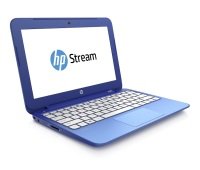
Entry-level Windows laptops may be peculiarly appealing as a compact, swell, all-in-1 PC with few cables needed (one to the weather station and perchance one to a mouse, if preferred) and with built-in WiFi for Cyberspace connectivity. Caveats about such laptops would include considering whether information technology's a good idea to run the laptop continuously with its battery connected (may be meliorate to remove the battery?); and a slight concern most the longevity of the eMMC memory with which such laptops are often fitted – as ever, a regular fill-in of weather data files is thoroughly recommended, simply in instance.
Small or net-pinnacle PCs
This category includes a diverse mixture of what might exist termed miniature desktop PCs, sometimes chosen net-top devices, but which all share desktop PC characteristics (i.eastward. all main circuit boards in a instance just with no born display, keyboard etc, unlike laptops) and in a very small-scale form-factor of around 100x100x50mm. There are a number of such devices made but here are three illustrations:
- Devices similar Intel NUC and Gigabyte Brix: While these can exist bought in set-to-become form, a more than cost-constructive option is to buy the bare-basic versions, which typically require memory, hard-drive and operating organization to exist added.
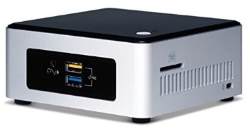
Intel NUC device This is in fact relatively simple to practise, but is obviously more suited to users with a little feel in hardware assembly. The neat do good of this arroyo is that a quality product can be created merely with a specification to adapt the individual user, eg if you lot adopt to use an SSD drive for storage and Linux equally the operating organisation and then it can be achieved at a good toll. The event will be a powerful only compact unit of measurement able to handle any corporeality of weather data processing that might realistically be needed.
- Comparable, fully finished devices from due east.g. Chinese factories that are sold under less familiar brand names such as Justop, Quantum Byte, Sumvision Cyclone, Minix Neo etc and available from Amazon amongst other outlets. These are typically sold at around the £100 mark with Windows 8/10 installed and oftentimes targeted at Smart TV or streaming media applications (though but equally suitable for handling conditions data). While these devices are reported to piece of work well every bit weather PCs, there are some potential concerns almost possible overheating of sure of the fanless designs, display driver compatibility and also over again in the use of eMMC (rather than practiced quality SSD) for permanent storage.
- Devices like the Intel Compute Stick, which is a notwithstanding smaller (100x37x12 mm) analogue of the NUC described above and designed to mountain straight into the HDMI socket of a suitable display monitor.
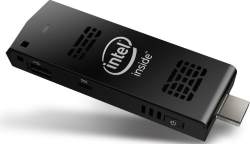
Intel Compute Stick In truth, the Compute Stick is non platonic having only a single costless USB port and therefore really needing to be used in combination with a small USB hub to allow connection of weather condition station and keyboard/mouse. And, once once again, the apply of eMMC as retention is a minor business organization. (Although either communication with e.one thousand. a WeatherlinkIP via the WiFi link or utilise of the Compute Stick in a headless configuration would presumably work fine.) But the Stick is interesting every bit an example of one management in which PC design is heading.
Overall, the ways in which the various PCs described in this section can be used will be diverse. But, in the main, the virtually likely configuration will be the familiar ane with brandish, keyboard and mouse attached to create a standalone PC running Windows software of 1 sort or another. Equally, yet, if the user preferred, the operating organisation could be a Linux variant, which would make it significantly simpler to run headless, i.e. with no display etc attached and with the PC being controlled from some other device on the network.
Information technology's inevitable of course that PC blueprint volition go along to evolve and new small desktop PCs will launch during 2016 and beyond. And then the in a higher place should be read merely equally a summary at one indicate in time (Dec 2015) and with the expectation that other newer devices volition always exist launching into the marketplace place.
Raspberry Pi and similar devices
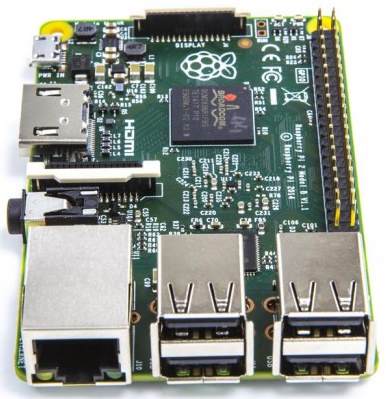
Single-lath computers (SBC) like the Raspberry Pi (RPi) have all of their components on a single small circuit board. (Other SBC examples include Assistant Pi and Beaglebone Black along with many others.)
These SBC devices are really little different in concept from, for example, the miniature desktops described above and and so are all role of the same continuum in functionality, but the farther reduction in size and power of SBC's does result in some pregnant practical differences:
- SBC's typically accept lower component resources, eg slower processors, less retention etc. They are therefore still cheaper and consume even less ability when running 24/7 but also, as a effect, cannot finer run Windows. They are therefore best viewed as Linux-merely devices, which of course limits the range of compatible software to programs such every bit Cumulus MX and weewx. However, exist in no doubtfulness that even an SBC like a Raspberry Pi tin be the basis of a highly capable weather condition PC and that a program like Cumulus MX is nevertheless total of powerful features.
- Users previously familiar only with Windows will detect it a modest hurdle to switch to Linux. However, the basics of learning Linux are adequately easy and one time some basic configuration commands are understood and then actually using the software is little different to a Windows environment.
- One benefit of switching to Linux is that it's pretty uncomplicated to run the device in headless fashion, ie having full control of the device from another computer on the network. Thus the RPi only needs to have power, weather station and network connections fabricated to it and and so the installation can be made very neat and simple. Of course, it still also works perfectly well in desktop mode with brandish, keyboard etc attached – the choice is downwards to the user'due south preference. (At that place are other benefits to Linux too such every bit the liberty from disruption caused past Windows auto-updates.)
- The total cost of eg a Raspberry Pi shouldn't be underestimated. While the RPi board itself is available for eg £20-30 (depending on exact version), past the time accessories like instance, mains adapter, SD bill of fare, WiFi dongle etc have been added in then the cost could rise to nearer £threescore. The RPi is still excellent value but the cost gap to other PC options is rather less striking.
- Remember one time once more that the RPi uses SD cards for storage, which are likely to have but a finite service life. Backup of conditions data files is an essential role of the daily/weekly routine.
MeteoBridge
The MeteoBridge family is described in detail on its own page, merely in summary:
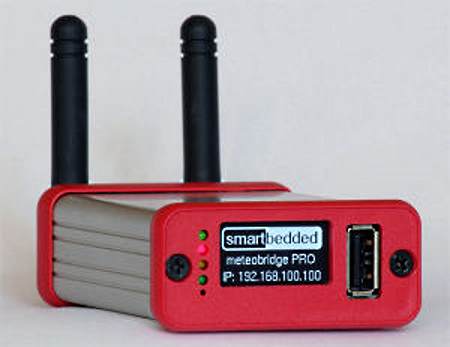 MeteoBridge is weather station software than tin can run on withal simpler PC hardware which probably represents about the minimum specification that can still back up highly effective data treatment with Internet uploads.
It should be clear from the notes in a higher place that in that location are many options when choosing a weather PC but, in a nutshell:
- If all you need is automated uploading of data to the Davis weatherlink.com service and are content with the limitations of that service then don't overlook the WeatherlinkIP logger as a solution – call back that the price includes unlimited access to weatherlink.com;
- One of the MeteoBridge models may besides provide an excellent solution for resilient and self-contained information handling with much greater flexibility than WeatherlinkIP offers;
- At the other farthermost, any standard Windows PC volition offer a wide option of uniform software including programs packed with many features such equally Cumulus or Weather Display. If buying a new PC then a small, cheap Windows laptop could be a good option;
- A miniature PC such as an Intel NUC unit is small, neat and free energy-efficient with more than than enough ability for crunching weather data. If fitted with a small (but genuine, ie not-eMMC) SSD for storage and Linux as an operating system then this might come close to an ideal conditions PC;
- A PC based on the Raspberry Pi ii is likely to be the cheapest new PC option and still has more than adequate power for number crunching. But remember to support data frequently.
gagnonthisity1943.blogspot.com
Source: https://www.weatherstations.co.uk/dedicatedwxpc.htm

Post a Comment for "Weather Stations That Use Pc to Upload"